Luxury Everest Base Camp Trek: Where the Comfort Ends
A luxury Everest Base Camp trek is comfortable for the lower half of the climb, and no further. The good lodges on the route stop at Deboche, just below Tengboche…

 Ankit Mishra
Updated on
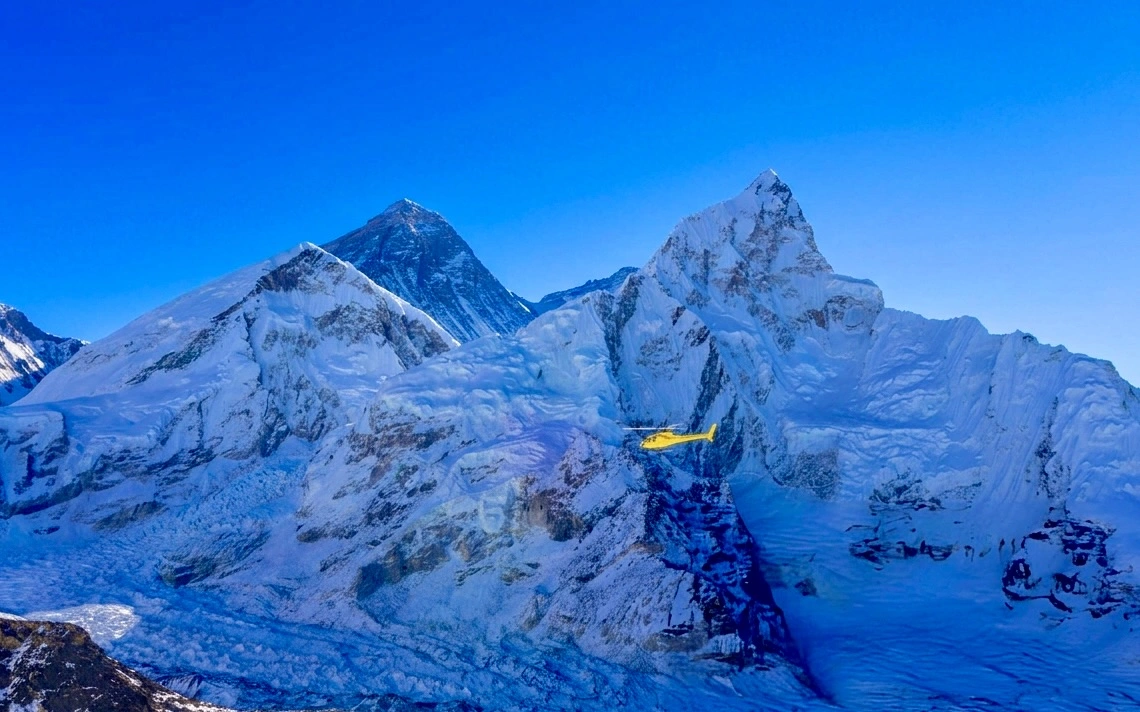
An Everest Base Camp helicopter tour flies up the Khumbu, passes over Base Camp and, when the weather allows, lands at Kala Patthar. Landing at Base Camp itself is not permitted. A plan agreed in February 2025 to limit sightseeing landings to below 4,300m is not being applied, so as of October 2026 the Kala Patthar stop is back on.
It is a remarkable flight, and the views are real. It also raises a question most tour pages skip: what flying straight to more than 5,000m does to a body that has not adjusted to it.
Who this guide is for: travellers weighing a helicopter tour against walking into the Khumbu, and anyone who has read that Kala Patthar landings were banned. It reflects how we plan the flight on our own Everest journey, and the position as it stands in October 2026.
Best for: understanding what an Everest helicopter tour can do under the current rules, before you book one.
When to use it: when you are deciding how to see Everest in the time you have.
Less useful if: you need a rescue flight, which follows separate medical rules.
It flies from Kathmandu into the Khumbu, passes over Base Camp and lands at Kala Patthar when the weather allows. That is the same pattern the Kathmandu Post described before 2025, when tours flew Kathmandu to Lukla to Kala Patthar, then stopped for lunch at the Everest View Hotel in Syangboche on the way back. In the peak season there were eight to ten such flights a day.
Then came two attempts to change it. In December 2024 the Khumbu Pasang Lhamu Rural Municipality decided that beyond Lukla, “only rescue and sling flights that comply with the laws and regulations of Sagarmatha National Park will be allowed,” the Kathmandu Post reported. A compromise in February 2025, reported by The Himalayan Times, approved mountain flights “for one-touch landings at altitudes below 4,300 meters”. That limit is not being applied. As of October 2026, tours land at Kala Patthar again, and only the weather stops them.
| Before January 2025 | The February 2025 plan | October 2026 | |
|---|---|---|---|
| Flying over Base Camp | Allowed | Allowed | Allowed |
| Landing at Base Camp | Not allowed for tours | Not allowed | Not allowed |
| Landing at Kala Patthar | The usual tour stop | Ruled out by a 4,300m limit | Back on, weather permitting |
Nepal’s aviation regulator disputes the power of local bodies to set these limits, and in December 2024 it said the national park had “no legal ground to enforce such a ban”. The position has moved more than once since, so check it close to your dates.
At Kala Patthar, yes, when the weather allows. At Base Camp, no. Base Camp has stayed off limits to tour landings: “Choppers are restricted from landing at the Everest base camp but can make an overfly,” the Kathmandu Post wrote in December 2024. Kala Patthar, more than 5,000m up, was the usual stop until January 2025. The February 2025 plan would have ruled it out, but its 4,300m limit is not being applied, and tours land there again.
The landing always depends on the weather. If cloud closes in, the helicopter flies over Base Camp and Kala Patthar without touching down, so treat the landing as likely rather than certain.
It is a recognised risk, and worth taking seriously. The UIAA’s medical commission lists rapid ascent to high altitude as a risk factor for altitude illness, and its first example is an “airport of destination at high altitude”. A helicopter tour does exactly that. It lifts you from Kathmandu, at about 1,350m, into the high Khumbu in a single flight, and a landing at Kala Patthar sets you down more than 5,000m up with no time to adjust.
Landings on these tours are brief, and anyone with a heart or lung condition should take medical advice before booking. For our own guests, we prefer to fly up the valley once they have already spent several nights at altitude.
Walking in first changes the picture. By the time our guests fly on the seventh day of Everest Above the Clouds, they have slept at Namche, which the Nepal Tourism Board places at 3,500m, and at Deboche below Tengboche. Their bodies have had days to adjust before the helicopter climbs.
Because thin air reduces what it can lift. In December 2024, the Kathmandu Post explained that “from Kathmandu, helicopters can carry four passengers in a light and medium helicopter up to Lukla. From Lukla, the chopper can take only two passengers to Kala Patthar.” So the higher the landing, the smaller the group per flight, which is one reason helicopter time in the Khumbu suits small private groups.
Once, as a record, and never as a tour. According to Guinness World Records, “the highest altitude at which a helicopter has taken off and landed is 8,848 m (29,029 ft), by Didier Delsalle (France) flying a Eurocopter AS 350 B3 at the summit of Mt Everest on 14 May 2005.” Nobody has turned it into a tour.
The law now points the other way. In May 2024, Republica reported, Nepal’s Supreme Court “banned the use of helicopters from the base camps to peaks, except for emergency rescue.” On the climbing routes above Base Camp, a helicopter is a rescue tool and nothing more.
Noise, wildlife and local livelihoods. The Kathmandu Post’s December 2024 report gave the park’s reasons plainly. “The animals jump off the cliffs in shock when choppers fly at low altitudes with big sounds,” it noted, and the park “has long warned helicopters to stop haphazard landings.” Local people also argued that helicopter rides had cut work for porters and guides and taken business from the teahouses.
Flying within the rules matters for that reason, beyond the paperwork. The Khumbu is a living valley, and a quieter sky is part of what makes it worth visiting.
The flight is best at the end of the walk. We schedule it for the seventh day of Everest Above the Clouds, after nights at Namche and Deboche, so guests take off already used to the altitude. In our experience that changes the whole morning, because the view gets their full attention.
For example, we keep a margin near the end of the journey, since helicopters wait for weather too. A delayed flight then uses up a spare day in Kathmandu instead of an international connection.
It depends on what you want from the day. Use this as a quick guide:
| If this matters most | The better fit |
|---|---|
| Seeing Base Camp and Everest in a single day | A helicopter tour from Kathmandu |
| Avoiding a sudden jump to altitude | Walking in first, then flying |
| Good lodges and time in the Sherpa villages | Everest Above the Clouds |
| Standing at Base Camp yourself | The trek, about two weeks on foot from Lukla |
Our own answer is to combine the two. On Everest Above the Clouds, guests fly by helicopter from Kathmandu to Lukla and then walk the comfortable half of the trail to Tengboche. On the seventh day a private helicopter lifts off near Deboche, flies over Base Camp and, weather permitting, lands at Kala Patthar, before carrying them out of the mountains.
If standing at Base Camp yourself is the point, our guide to the luxury Everest Base Camp trek sets out where the comfort ends on the walk. For the weather side of either choice, our guide to the best time to trek in Nepal works from the Department of Hydrology and Meteorology’s own monsoon records.
Not on a tour. Landing at Base Camp is not permitted, so tours fly over it instead. They can land at Kala Patthar, above Gorak Shep, when the weather allows.
Only once, as a record. Didier Delsalle landed a Eurocopter AS 350 B3 on the summit on 14 May 2005, according to Guinness World Records. In 2024 Nepal’s Supreme Court banned helicopters from the base camps to the peaks, except for emergency rescue, so no tour flies up the climbing routes to the summits.
Yes, when the weather allows. A February 2025 plan to limit sightseeing landings to below 4,300m is not being applied, so as of October 2026 tours land at Kala Patthar again. If cloud closes in, the flight passes over without landing.
No. The Khumbu agreed a 4,300m limit on sightseeing landings in February 2025, but it is not being applied. As of October 2026, tours land at Kala Patthar when the weather allows, while Base Camp remains overfly only.
Fewer the higher it goes. In December 2024, the Kathmandu Post noted that a light or medium helicopter could carry four passengers to Lukla but only two on to Kala Patthar, because thin air reduces what it can lift.
It carries a recognised risk. The UIAA lists rapid ascent to high altitude as a risk factor for altitude illness, with an airport at high altitude as its first example. Walking in for a few days before flying gives your body time to adjust first.
Combine a short walk with a flight. Walking to Tengboche keeps you in comfortable lodges and lets your body adjust, and a sightseeing flight up the valley then shows you Base Camp and Everest from the air, with a landing at Kala Patthar when the weather allows.
Noise, wildlife and local jobs. The Kathmandu Post reported animals jumping off cliffs in shock at low-flying helicopters, and the park had long warned against haphazard landings. Local people also said helicopter rides were taking work from porters, guides and teahouses.
Send us your questions about routes, costs or the best time to go — our travel experts in Nepal reply within 24 hours.

A luxury Everest Base Camp trek is comfortable for the lower half of the climb, and no further. The good lodges on the route stop at Deboche, just below Tengboche…

Both routes are superb and they suit different people. Altitude, access and the shape of the walk are what actually separate them.