Nepal Luxury Tour and Trekking: What It Actually Means
Nepal receives more visitors than ever, yet daily spend sits near a record low. Here is what luxury trekking in Nepal should actually mean.

 Ankit Mishra
Updated on
Ankit Mishra
Updated on
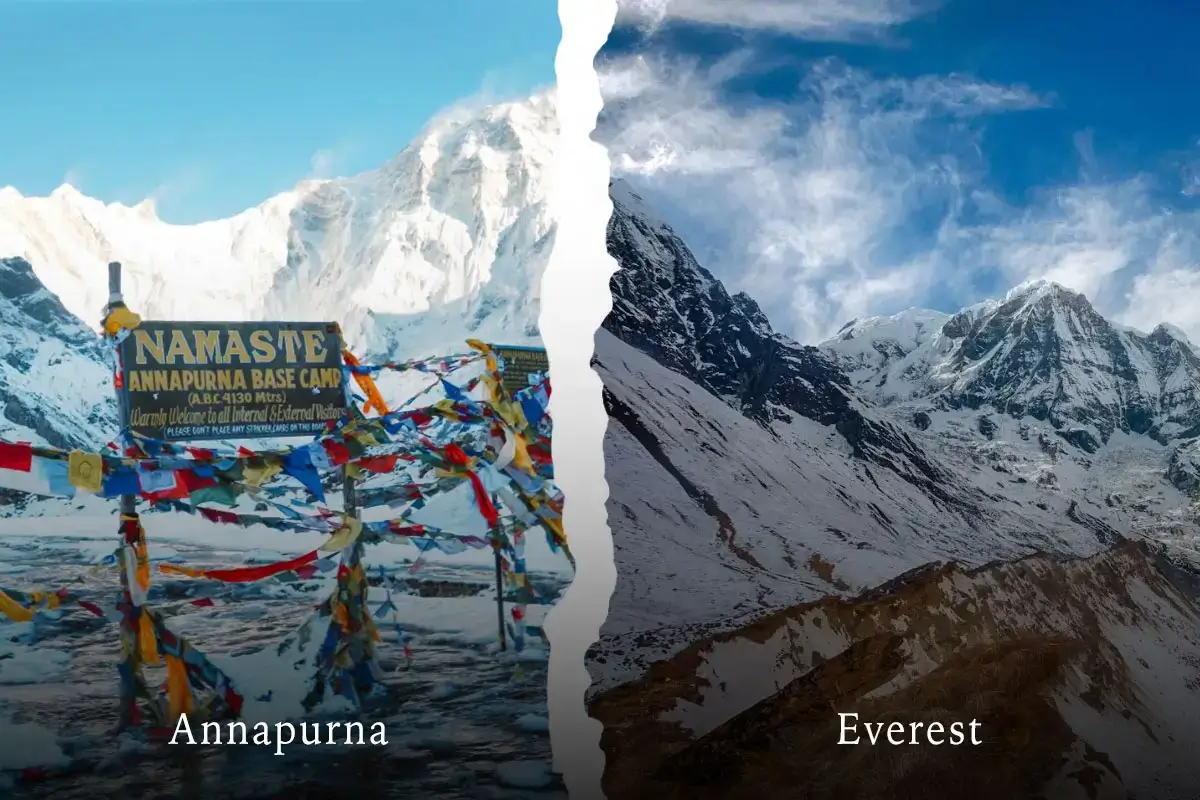
The Annapurna vs Everest Base Camp question comes down to altitude, access and the shape of the walk. Annapurna Base Camp suits travellers who want a classic Himalayan walk without extreme altitude or a mountain airstrip. It sits at 4,130m, and because the approach runs by road through Pokhara, there is no mountain airstrip to miss. Everest Base Camp, meanwhile, goes much higher and also needs a flight into Lukla. Both are excellent walks, although they suit different people. Still, they are not the same trip.
Here is how the two actually differ, and therefore which questions should settle it for you.
| Annapurna Base Camp | Everest Base Camp | |
|---|---|---|
| High point | 4,130m at Base Camp | Higher, with Kala Patthar at 5,545m |
| Access | Road from Pokhara | Flight into Lukla |
| Weather risk | Costs you comfort | Can cost you days |
| Protected area | Annapurna Conservation Area | Sagarmatha National Park |
| Entry fee, foreign nationals | NRs 3,000 | NRs 3,000 |
| Culture on the trail | Gurung and Magar villages | Sherpa and Tibetan Buddhist |
| Licensed guide | Required since 31 March 2023 | Required since 31 March 2023 |
| Suits | A first Himalayan trek, and fixed dates | Khumbu specifically, and a flexible return |
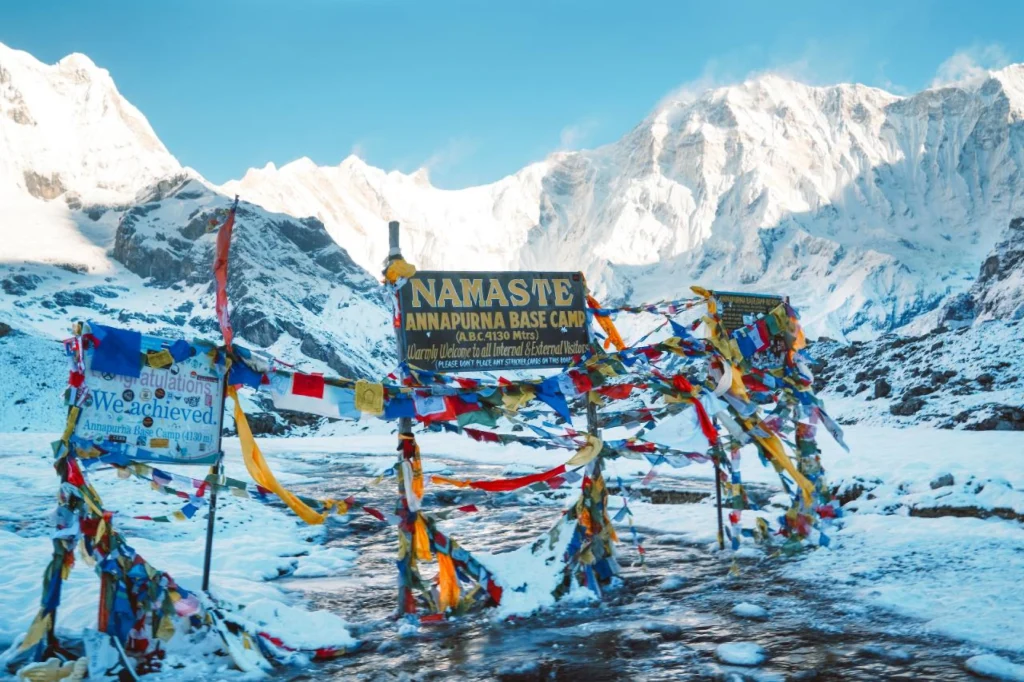
Annapurna Base Camp sits at 4,130m, a figure reported by The Kathmandu Post, which places the site in Annapurna Rural Municipality in Kaski. The route reaches it gradually, since it passes Machhapuchhre Base Camp on the final morning.
Everest goes higher, so most itineraries also add a viewpoint above the base camp itself. The Nepal Tourism Board records Kala Patthar, the usual sunrise point above Gorak Shep, at 5,545m. That is well over a kilometre above the Annapurna high point.
That gap matters more than the raw numbers suggest, because altitude risk is not linear. Altitude illness risk climbs steeply with height, and faster still with a quick ascent. It climbs faster still with the speed of the ascent. Research at the Mustang district hospital in Jomsom found that compressing a 2,978m ascent from three days into one roughly doubled the odds of moderate or severe symptoms.
So if anyone in the party is wary about altitude, Annapurna is the gentler introduction. You still stand under an 8,000m peak. Annapurna I, however, rises to 8,091m directly above the Sanctuary.
The Annapurna approach runs through Pokhara, then by road to the trailhead. Everest requires a flight into Lukla, an airstrip whose schedule depends heavily on mountain weather.
Delays there are common in poor conditions, so a fixed schedule is a real risk. As a result they can cost days at either end of a trip. You cannot plan around them more than a day or two ahead. For a traveller whose return date is fixed by something that will not move, that single fact is often what decides the question.
Annapurna simply has more reliable access. A bad weather day costs you comfort. In the Khumbu it can cost you the trip.
Annapurna climbs through farmland, Gurung villages and rhododendron forest. Then the valley narrows and the walls close in. The reward is the Sanctuary itself, a ring of peaks with Annapurna I on one side and Machhapuchhre on the other. You are surrounded, and that enclosure is the thing people remember.
Everest is starker and higher. It is a walk through Khumbu with Sherpa villages and monasteries along the way, and the scale is hard to take in. The ground is barer, though, and the base camp itself is a glacier rather than a viewpoint. That is why the sunrise walk up Kala Patthar exists at all.
In short: Annapurna closes around you. Everest gives you scale, and a name everyone at home knows.
The Annapurna region is Gurung and Magar country, with farming villages set into terraced hillsides. Khumbu is Sherpa and Tibetan Buddhist, with monasteries at altitude.
Neither is better. However, if the cultural half of the trip matters to you, Annapurna sits closer to Pokhara and the Kathmandu Valley. That makes it easy to pair the walk with time among the seven monument zones that make up the valley’s UNESCO World Heritage property, inscribed in 1979.
Khumbu rewards a different appetite. If Tibetan Buddhist practice at altitude is what draws you, no amount of Annapurna scenery takes its place.
Annapurna sits inside the Annapurna Conservation Area, managed by the National Trust for Nature Conservation. Everest lies within Sagarmatha National Park. Both now require a licensed guide under the rules that took effect on 31 March 2023.
The entry fee for foreign nationals is NRs 3,000 in both areas, according to the Nepal Tourism Board. The SAARC rate differs, at NRs 1,000 for Annapurna and NRs 1,500 for Sagarmatha. Our guide to Nepal trekking permits sets out the current position, including the TIMS card.
A properly paced Annapurna Base Camp walk takes about six trekking days to reach 4,130m. Add city time at either end and a full journey runs to around a fortnight.
Everest takes longer. The extra height needs more rest days built in, and the Lukla flight needs slack in the schedule on both sides. If the time you can be away is the real limit, Annapurna gives you a full Himalayan trip in fewer days.
These get confused constantly, and they are different walks.
Annapurna Base Camp goes into the Sanctuary and back out the same valley system, finishing under the peaks. The Annapurna Circuit goes around the massif, crosses a high pass, and comes down into a dry, Tibetan landscape on the far side. The Circuit is longer and reaches a higher point at the pass.
Base Camp is the better choice when the goal is to stand inside the mountains rather than to cover ground. The Circuit suits walkers who want distance and changing terrain, and who have the days to give it.
There is a practical point behind the choice, too. A road now reaches further up the Circuit than it once did, which has changed some sections and shortened others, while the walk into the Sanctuary still ends on foot in a place no vehicle can reach. For a guest who has flown a long way to be somewhere that feels genuinely remote, that difference is not a small one.
Choose Annapurna if you want a lower maximum altitude, reliable road access, greener scenery, and easy cultural time in the Kathmandu Valley.
Choose Everest if the name matters to you, if Sherpa Khumbu is specifically what you came for, and if your schedule can absorb weather delays at Lukla without the trip unravelling.
We have a journey on each side. Our 14 day Annapurna journey walks to Annapurna Base Camp. Our private Everest journey walks into the Khumbu as far as Tengboche rather than to Base Camp, and sees the high valley from the air. If Base Camp itself is the goal, our guide to the luxury Everest Base Camp trek sets out where the comfort ends and what the helicopter rules now allow.
Everest, mainly because of altitude. Its high points sit well above the 4,130m of Annapurna Base Camp, and the route needs more rest days.
Annapurna Base Camp is 4,130m. The Everest routes go much higher. The Nepal Tourism Board puts Kala Patthar at 5,545m.
No. They are separate ranges, several hundred kilometres apart.
Different views. Annapurna closes a ring of peaks around you. Everest gives you scale and distance.
Yes. The rule introduced on 31 March 2023 covers specified protected areas, and both regions are included.
Annapurna, in most cases. Lower altitude, road access rather than a mountain flight, and fewer days needed.
Base Camp walks into the Sanctuary and back. The Circuit goes around the massif over a high pass. The Circuit is longer and higher at its top point.
Send us your questions about routes, costs or the best time to go — our travel experts in Nepal reply within 24 hours.

Nepal receives more visitors than ever, yet daily spend sits near a record low. Here is what luxury trekking in Nepal should actually mean.
A year of emergency ward data from Jomsom shows how much ascent rate matters. The finding should shape how any itinerary is built.