Nepal Luxury Tour and Trekking: What It Actually Means
Nepal receives more visitors than ever, yet daily spend sits near a record low. Here is what luxury trekking in Nepal should actually mean.
 Pawan Bhattarai
Updated on
Pawan Bhattarai
Updated on
A Nepal retreat means joining a practice that was already running long before anyone thought to sell it. Three traditions sit here side by side. Tibetan Buddhist meditation, taught in working monasteries around the Kathmandu Valley. Hindu practice, centred on Pashupatinath and the Bagmati. And Ayurvedic medicine, which the Nepali state licenses through the Department of Ayurveda and Alternative Medicine under the Ministry of Health and Population.
None of that was designed with visitors in mind. That is the reason it still holds. It is also why the gap between a genuine retreat and a hotel spa using the vocabulary is so wide here, and so easy to miss from the outside.
People use “retreat” as one word for four different things in Nepal. Knowing which one you actually want saves a wasted fortnight.
| Tradition | What it involves | Usual length | What to check first |
|---|---|---|---|
| Tibetan Buddhist | Instruction inside a working monastery timetable | A weekend to a month | Who teaches, by name |
| Vipassana | Silence, no phone, no reading, donation based | Ten days, fixed | Nothing. The terms are identical for everyone |
| Ayurveda | Prescribed clinical treatment, usually Panchakarma | One to three weeks | BAMS degree and registration number |
| Yoga | Private practice with an experienced teacher | Flexible | That it is not 200-hour teacher training |
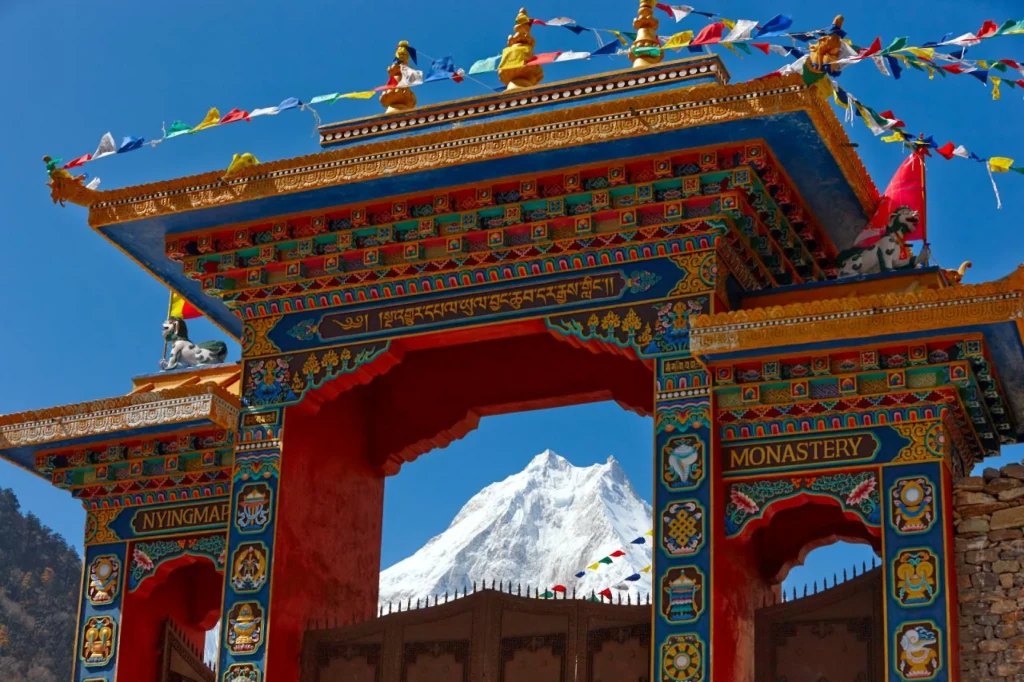
The Kathmandu Valley became a centre of Tibetan Buddhist scholarship after 1959, when monasteries were rebuilt in exile around Boudhanath. Today the stupa sits inside a ring of working gompas. Kopan, on a hill above Boudhanath, runs structured courses. Pharping, an hour south, holds the cave where Guru Rinpoche is said to have attained realisation, and it remains a place of serious practice rather than sightseeing.
What you get here is instruction inside a live monastic timetable, which means the day is shaped by the monastery rather than by the visitor, and the teaching happens at the hour it has always happened, guest or no guest. Nobody adjusts the schedule. That is the value. Access to a senior lama is possible, although it is arranged person to person, and it is never sold as an extra.
Vipassana courses in Nepal run for ten days, in silence, on donation. Dhamma Shringa at Budhanilkantha above Kathmandu is the best known centre. You hand over your phone. You do not speak, read or write. You sit for roughly ten hours a day, and you eat what everyone eats.
There is no better room. There is no shorter version. A guest who has chartered a helicopter to reach the trailhead will sleep in the same plain cell as a student from Pokhara, because the tradition does not permit anything else. In fact this is the point worth understanding about Nepal: the most respected practice in the country is the one nobody can pay to improve.
Ayurveda in Nepal is a licensed medical practice, not a spa treatment. The Nepal Tourism Board describes the tradition and its clinical use in its guide to Ayurveda, and it covers Panchakarma, the multi-stage cleansing programme that forms the core of serious treatment. Panchakarma is not a massage. It runs for one to three weeks, it is prescribed after a consultation, and it changes what you eat and when you sleep.
The Nepali government now allows only certified professionals to operate Ayurveda clinics, a shift The Kathmandu Post examined in its piece on traditional healing and regulation. So the single most useful question you can ask is whether the practitioner holds a BAMS degree and a registration number, and whether the clinic is registered with the Department of Ayurveda. A resort spa offering an “Ayurvedic-inspired” treatment is answering a different question.
Nepal has a large yoga industry and most of it is built around 200-hour teacher training, sold to people who want a certificate. Those courses are cheap, crowded and aimed squarely at long-stay budget travellers. They are perfectly legitimate. They are simply not a retreat.
A private practice with an experienced Nepali teacher is a different proposition, and it is arranged rather than booked. Since almost every search result for yoga in Nepal points at teacher training, however, this is the distinction most people never make. So ask what you are actually buying. The answer comes quickly.
| Where | Suits | Character |
|---|---|---|
| Kathmandu Valley | Meditation and Ayurveda | The densest concentration of teachers and licensed clinics in Nepal |
| Lumbini | Buddhist pilgrimage | Flat and hot. The sacred garden, plus monasteries built by other countries |
| Pokhara and the lakes | Practice alongside walking | Begnas and Rupa are quiet. The Annapurna wall rises out of the water |
Kathmandu Valley. The densest concentration of teachers, monasteries and licensed Ayurvedic clinics in the country. Boudhanath, Pharping, Namo Buddha and Nagarkot are all within two hours of each other. Namo Buddha in particular sits on a forested ridge with the Himalaya on the skyline, and it is quiet in a way central Kathmandu is not.
Lumbini. The birthplace of the Buddha, inscribed by UNESCO in 1997 and described by the Nepal Tourism Board as the origin point of Buddhism itself. The sacred garden holds the Maya Devi Temple and the Ashokan pillar. Around it, individual countries have each built their own monastery, so an afternoon on foot takes you from a Thai temple to a Burmese one to a German one without leaving the grounds. It is flat. It is hot. And it is nothing like the mountains, which is why so few itineraries bother with it and why the ones that do tend to be the serious ones.
Pokhara and the lakes. Begnas and Rupa are the quiet alternative to Phewa. The Annapurna wall rises straight out of the water on a clear morning. Retreats here trade monastic rigour for space and air, which suits guests who want practice alongside walking rather than instead of it.
Most people who come for practice also want to see the Himalaya, and the two fit together better than they sound. Altitude does something to attention that a quiet room cannot replicate. Our Himalayan Renewal journey puts four nights on the Dhulikhel ridge with Ayurveda under a BAMS practitioner, and the Annapurna journey carries wellness days at the start and the end for exactly this reason: you arrive, you slow down, you walk, then you come back down and let the body settle before flying home. How the walking itself is handled matters just as much, and our guide to luxury trekking in Nepal sets out what changes when it is done properly.
The sequencing matters more than the ingredients. A massage on the evening you land does very little. Three unhurried days before the walking starts, then Ayurvedic treatment after the descent, is a completely different experience, because by then there is something to recover from.
October and November are clear, dry and busy. March through May is warm, with rhododendron in flower across the middle hills. Both are the standard windows and both work.
Still, a retreat is one of the few things in Nepal that does not need a view. Winter in the Kathmandu Valley is sunny by day and cold at night, and the monasteries are almost empty of visitors. Even the monsoon, which rules out most trekking, leaves the valley green and the practice untouched. If your priority is quiet rather than mountains, the off months are better, not worse. We go through this in more detail in our guide to the best time to trek in Nepal.
Four questions separate a real programme from a marketed one.
It is a stay built around a practice tradition rather than around sightseeing. In Nepal that usually means Tibetan Buddhist meditation, Vipassana, Ayurvedic treatment, or private yoga instruction, held at a monastery, a licensed clinic or a quiet lodge outside the city.
Ten days is the standard length for a formal Vipassana course, and the tradition does not shorten it. Monastery courses run from a weekend to a month. For Panchakarma, one week is the practical minimum and two to three weeks is where the real benefit sits.
No. Introductory courses at Kopan and the main Vipassana centres assume no background at all. What they do assume is that you will keep the timetable, which is stricter than most first-timers expect.
Yes. The Department of Ayurveda and Alternative Medicine sits under the Ministry of Health and Population, and only certified professionals may operate Ayurveda clinics. Practitioners hold a BAMS degree and a registration number. A hotel spa using the word is not the same thing, so ask.
Yes, and it usually should be. Wellness days before the walk help you adjust after a long flight. Treatment after the descent works on a body that has actually done something. Our Annapurna journey is built this way.
Autumn and spring are the most comfortable. However, a retreat does not depend on mountain views, so winter and even the monsoon work well in the Kathmandu Valley, and they are far quieter.
Send us your questions about routes, costs or the best time to go — our travel experts in Nepal reply within 24 hours.

Nepal receives more visitors than ever, yet daily spend sits near a record low. Here is what luxury trekking in Nepal should actually mean.

Nepal counted 429 wild tigers in 2026, nearly four times its 2010 figure. What that means on the ground, and how Chitwan and Bardia differ.