Nepal Luxury Tour and Trekking: What It Actually Means
Nepal receives more visitors than ever, yet daily spend sits near a record low. Here is what luxury trekking in Nepal should actually mean.
 Pawan Bhattarai
Updated on
Pawan Bhattarai
Updated on
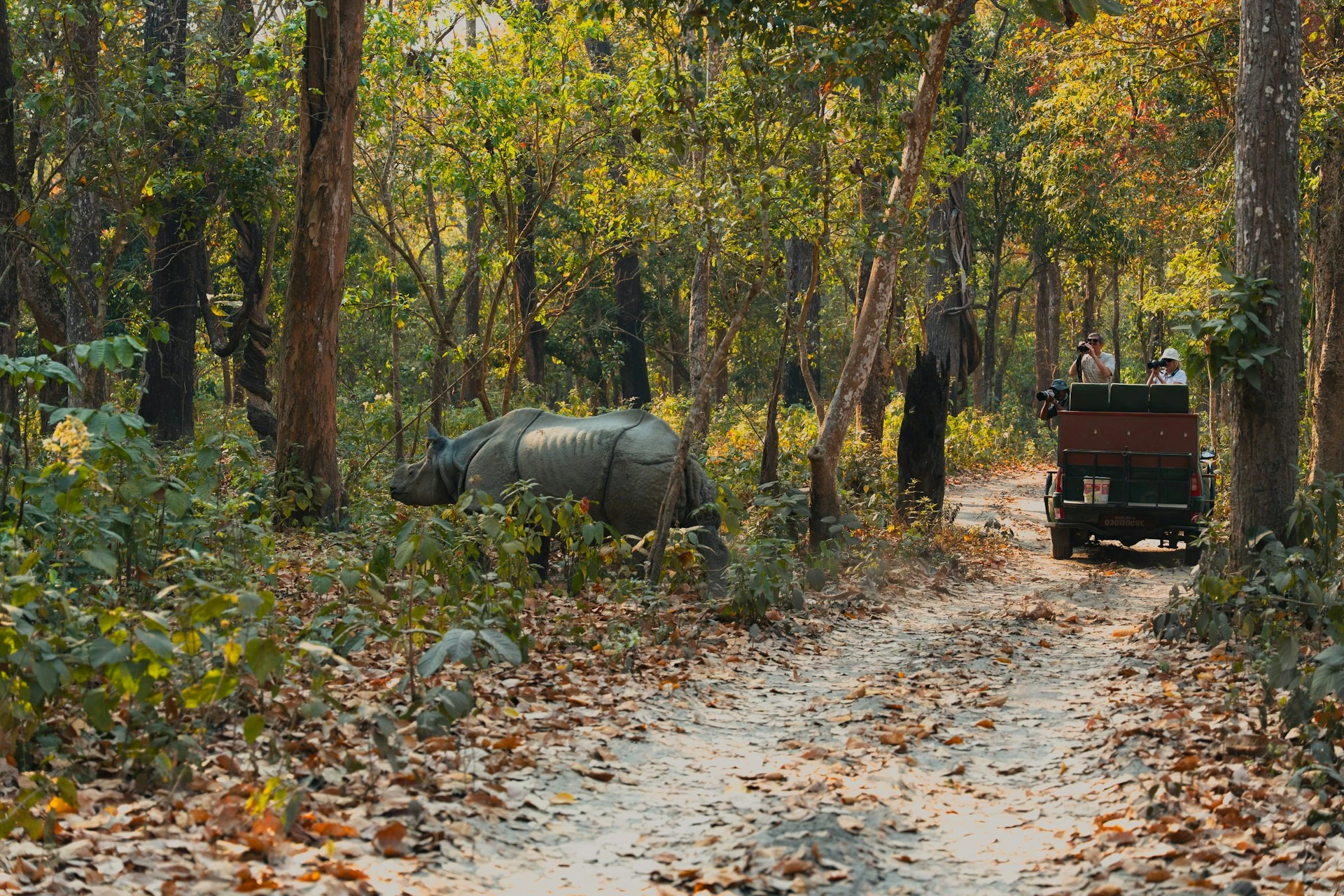
A Nepal safari happens in the Terai, a belt of lowland jungle along the southern border, and it looks nothing like the mountains most visitors come for. Nepal counted 429 wild tigers in its 2026 national census, up from 355 in 2022 and close to four times the number recorded in 2010, reported by The Kathmandu Post. The country also holds roughly 752 greater one-horned rhinos. Almost all of them live a few hours from Kathmandu.
This is the part of Nepal that visitors skip. It is also, on the numbers, one of the strongest big-cat recoveries anywhere.
The survey ran from December 2025 to July 2026, led by the Department of National Parks and Wildlife Conservation with the Department of Forests and Soil Conservation. Camera traps did the counting.
Four of those five parks rose. Bardiya is the exception.
That drop matters more than the headline. Conservationists reading the same census raised concerns about habitat rather than celebrating the total, because a recovering predator population needs room and prey, not just protection. Meanwhile The Kathmandu Post reported in August 2026 that rhinos in Bardiya have been crossing into India looking for water and better grazing. Success here is real, and it is not settled.
The rhino figure comes from the 2021 national census, which found 752, with 694 of them in Chitwan alone, reported by The Kathmandu Post. The follow up count has now been shelved for a second year running and pushed to 2027, because the budget went to the tiger survey instead. So 752 stands as the most recent official number rather than a current one. Anyone quoting you a fresher figure is guessing.
They are not interchangeable, and the choice comes down to what you are willing to trade.
| Chitwan | Bardia | |
|---|---|---|
| Tigers, 2026 | 145 | 112 |
| Rhinos, 2021 count | 694 | 38 |
| Best for | Rhino, and a shorter trip | Tigers, and solitude |
| Getting there | About five hours by road, or fly to Bharatpur | Fly to Nepalgunj, then drive |
| Status | Nepal’s first national park, 1973. UNESCO listed 1984 | Largest park in the Terai |
| Visitor pressure | High on the popular routes | Low |
Nepal’s first national park, gazetted in 1973 and inscribed by UNESCO in 1984. It sits about five hours from Kathmandu by road, or a short flight to Bharatpur. Rhino sightings are close to reliable. Tiger sightings are not, though the density is the highest in the country.
The trade is people. Chitwan is the established destination, so the buffer zone carries a lot of infrastructure and the popular routes get busy. Even so, the park is large, and how much of that you notice depends entirely on where you stay and which sector you enter.
Further west, harder to reach, and much quieter. Bardia is where people go specifically to look for tigers, because the forest is more open in places and the pressure from visitors is lower. Sightings still take patience and several days. Nobody should promise you a tiger.
Getting there means a flight to Nepalgunj and then a drive, which is why it stays quiet. For a guest with the time, that difficulty is the attraction.
Rhinos, very likely. Chitwan’s population is dense enough that several days in the park usually produce more than one encounter, from a vehicle, from a canoe on the Rapti or on foot with a guide.
One thing worth settling before you arrive: we do not put guests on elephant back. Ridden elephant safaris are still sold in Chitwan, and the welfare case against them is strong enough that most serious wildlife operators have stopped. Jeep, canoe, hide and foot see more anyway, because a quiet vehicle does not announce itself for half a kilometre.
Tigers, possibly. That is the honest answer and it is worth stating plainly, because the alternative is a guest who feels cheated. With 145 tigers spread across roughly 950 square kilometres of dense forest and tall grass, a sighting is a matter of hours in the field and luck, in that order. Some guests see one on the first morning. Others spend a week and find pugmarks in the dust.
Beyond the two headline animals, the Terai holds:
February through April is the best window. The grass has been cut, visibility through the undergrowth is at its best, and animals concentrate around shrinking water. April gets hot, which improves sightings and reduces comfort.
October to January is pleasant, though the elephant grass is still tall after the monsoon and it hides a great deal. Avoid June to September, since the Terai floods, tracks close and the heat is heavy.
Note that this runs almost opposite to the mountain calendar. If you want both on one trip, late February through early April is where the two windows genuinely overlap, and our guide to seasons in Nepal sets out why.
Nepal is small enough that the jungle and the high mountains sit within a day of each other, which is unusual. A guest can walk below Annapurna one week, then track rhino on the Rapti the next. If the mountain half is what draws you, our guide to luxury trekking in Nepal covers how that side is run. For fitting both halves into one trip, see a tour plan for Nepal.
We build private journeys around what a guest wants to see rather than around a fixed route, so if wildlife matters to you, say so early and it shapes the plan. Our Wild Himalaya journey gives Chitwan four nights, which is what it takes to stop rushing a sighting. Bardia is arranged on enquiry.
Yes. Nepal has five lowland national parks with tigers and rhinos, of which Chitwan and Bardia are the two usually visited. Safari here means jeep drives, walking safaris with an armed guide, canoe trips and hides, rather than the open-plain game viewing of East Africa.
429, according to the national census published in July 2026. Chitwan holds 145 and Bardiya 112. The figure has nearly quadrupled since 2010.
Chitwan for rhinos, easier access and a shorter trip. Bardia for tigers, solitude and a serious wildlife focus. Bardia takes longer to reach, which is precisely why fewer people are there.
Possibly, and anyone who guarantees it is selling you something. Density is high by global standards but the forest is thick. Three or four days in the field gives a reasonable chance. One afternoon does not.
February to April. The grass is short, water is scarce and animals are easier to find. Skip the monsoon months from June to September, because the Terai floods and tracks close.
About five hours by road, or roughly 25 minutes by air to Bharatpur followed by a short drive. Bardia is much further west and needs a flight to Nepalgunj.
Send us your questions about routes, costs or the best time to go — our travel experts in Nepal reply within 24 hours.

Nepal receives more visitors than ever, yet daily spend sits near a record low. Here is what luxury trekking in Nepal should actually mean.

Nepal holds three unbroken practice traditions and a large industry built to imitate them. How to tell the difference, where the real teachers sit, and what to ask before you…