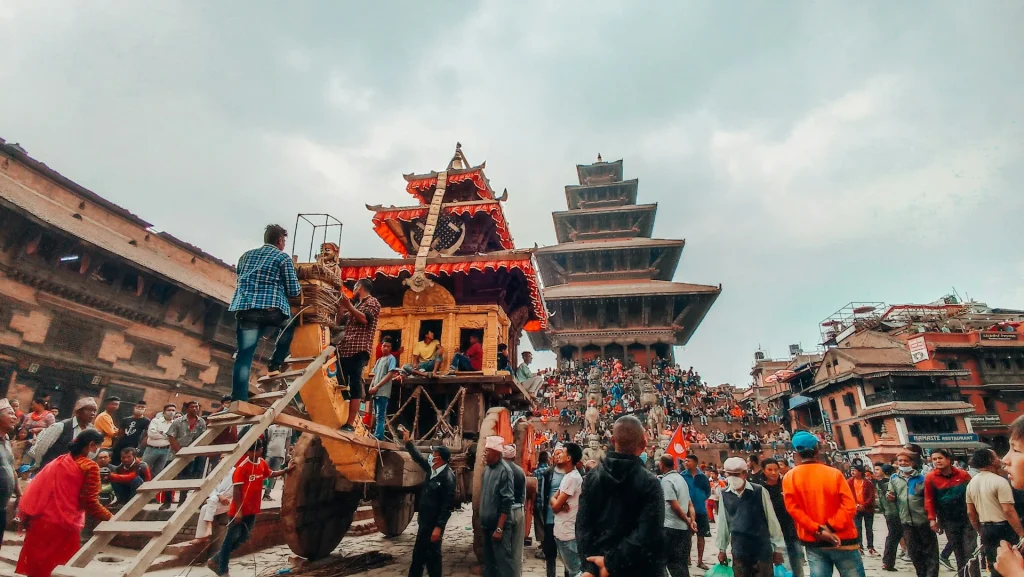
A Tour Plan for Nepal: How to Structure Two Weeks
A tour plan for Nepal works best built around three or four places, not eight. The country is small on a map and slow on the ground, so the itineraries…

 Pawan Bhattarai
Updated on
Ten days in Nepal is enough for the Kathmandu Valley and one region beyond it, with a day kept spare for the weather. A second region fits only if neither of them involves walking at altitude. So the art of a short trip is the cutting. This guide sets out four private routes that each do one thing properly: the Annapurna foothills, Everest from the air, the kingdom of Mustang, or the jungle followed by rest.
Who this guide is for: travellers with a Nepal itinerary 10 days long to fill, who want to see how the days fall before choosing a route. It follows how we plan our own private journeys at Far Ridge Collective, a travel company registered in Nepal, operating private treks, tours, wellness and wildlife journeys, and every figure in it comes from a named source, most of them Nepali government bodies and national newspapers.
Best for: a first visit with one clear interest, or a second visit to the region you missed last time.
When to use it: once your dates are fixed and the question is what to leave out.
Less useful if: you want the mountains and a safari in the same trip. That fits better in two weeks, as our 14 day Nepal itinerary shows.
Take out the day you land and the day you leave, and ten days gives you eight full ones. The Valley deserves two of them at least, since it holds seven monument zones inside one UNESCO World Heritage property. The spare day takes another. That leaves five, which is enough for one region done properly. It is not quite enough for two, because every move between regions uses most of a day once you count the transfers at either end of the flight.
Here is how the nine nights fall on each of the four routes.
| Route | Kathmandu Valley | The region beyond | Spare day | High point |
|---|---|---|---|---|
| The Annapurna foothills | 3 nights, then 1 | Pokhara and Ghandruk, 5 nights | Day 9 | About 2,000m |
| Everest from the air | 2 nights, then 3 | The Khumbu, 4 nights | Day 8 | 3,867m on foot, 5,545m by helicopter |
| The kingdom of Mustang | 2 nights, then 1 | Pokhara and Mustang, 6 nights | Day 8 | Just under 3,800m |
| Wildlife, then rest | 2 nights, then 1 | Chitwan 3 nights, Dhulikhel 3 | Day 9 | About 1,550m |
All four begin and end in Kathmandu, and all four keep a spare day near the end.
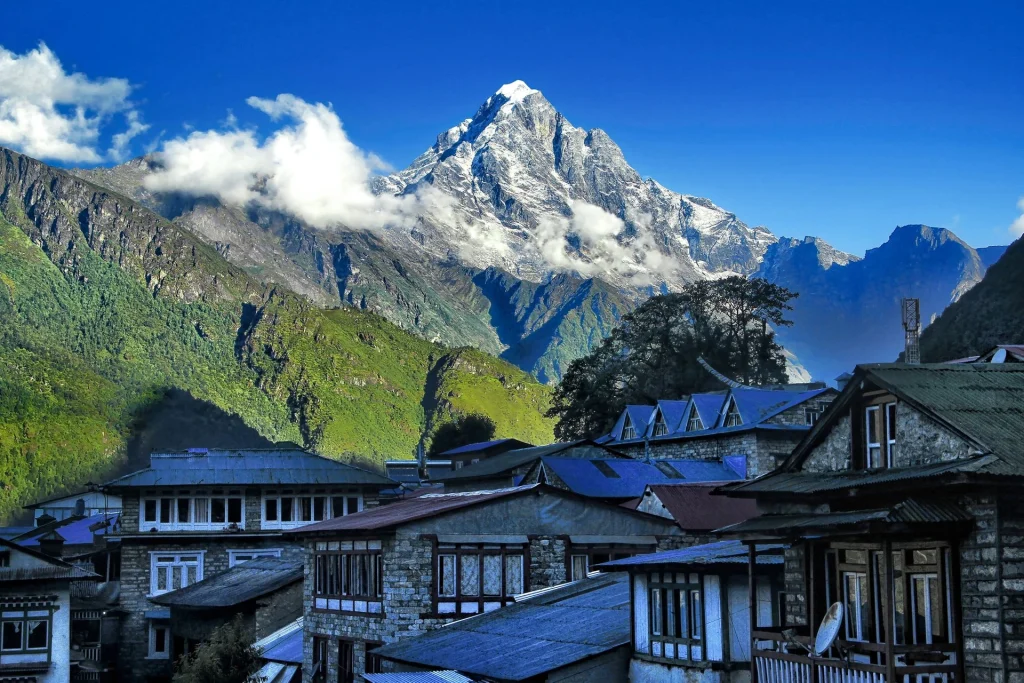
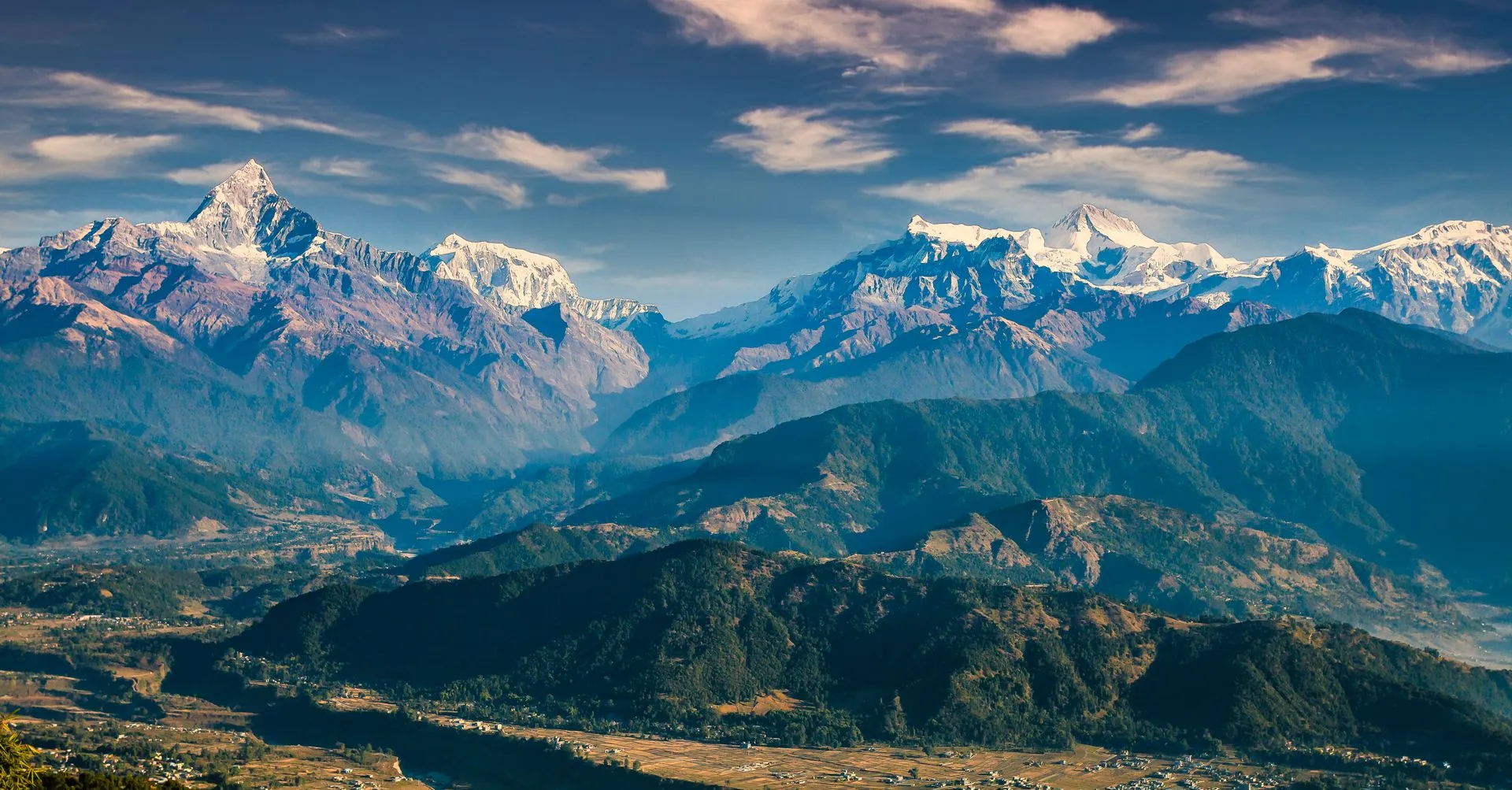
For most first visits, this is the route we would choose. It gives you the Valley properly, then the Annapurna range at close quarters, and it never climbs much above 2,000m, so altitude never sets the pace and nobody in the party has to wonder how they will sleep at height.
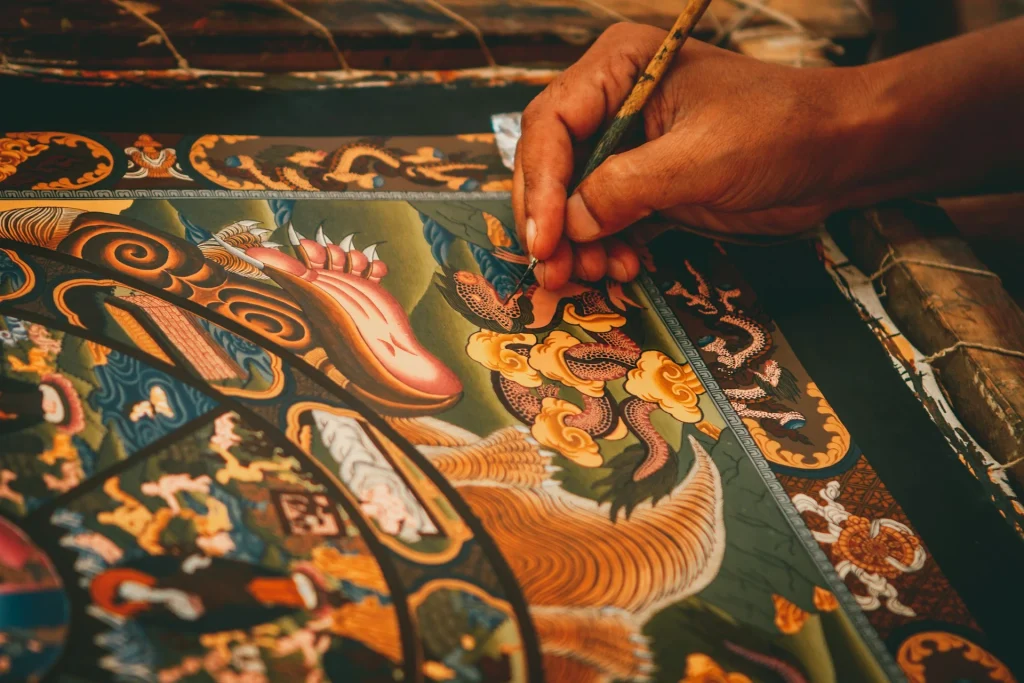
Three nights in the Valley leave room for its quieter side. Behind the durbar squares are courtyards reached through low doorways, and workshops where Newar metalworkers and thangka painters work to patterns set generations ago, and an hour spent watching them tells you more about the Valley than a morning of monuments. Then a 25-minute flight takes you to Pokhara, and a short drive and a walk on stone paths bring you to Ghandruk, a Gurung village that faces Annapurna South and Machhapuchhre across the valley. Its Gurung museum tells the village’s own story, including the sons it sent to fight in two world wars.
| Days | Where | What happens | Nights |
|---|---|---|---|
| 1 | Kathmandu | Arrival, and an unhurried evening | Heritage hotel, Kathmandu |
| 2 to 3 | Kathmandu Valley | The squares of Kathmandu and Patan, then the courtyards and workshops behind them | Heritage hotel, Kathmandu |
| 4 to 5 | Pokhara | A short flight west. Phewa Lake, and the range at dawn | Lakeside lodge, Pokhara |
| 6 to 7 | Ghandruk | Up into the foothills on foot. Stone paths, the Gurung museum, Annapurna South across the valley | Mountain lodge, Ghandruk |
| 8 | Pokhara | Down to the lake for the afternoon | Lakeside lodge, Pokhara |
| 9 | Kathmandu | Fly back. The spare day | Heritage hotel, Kathmandu |
| 10 | Kathmandu | Departure |
These days are taken from The Grand Nepal Journey, which adds Chitwan and Dhulikhel over sixteen days.
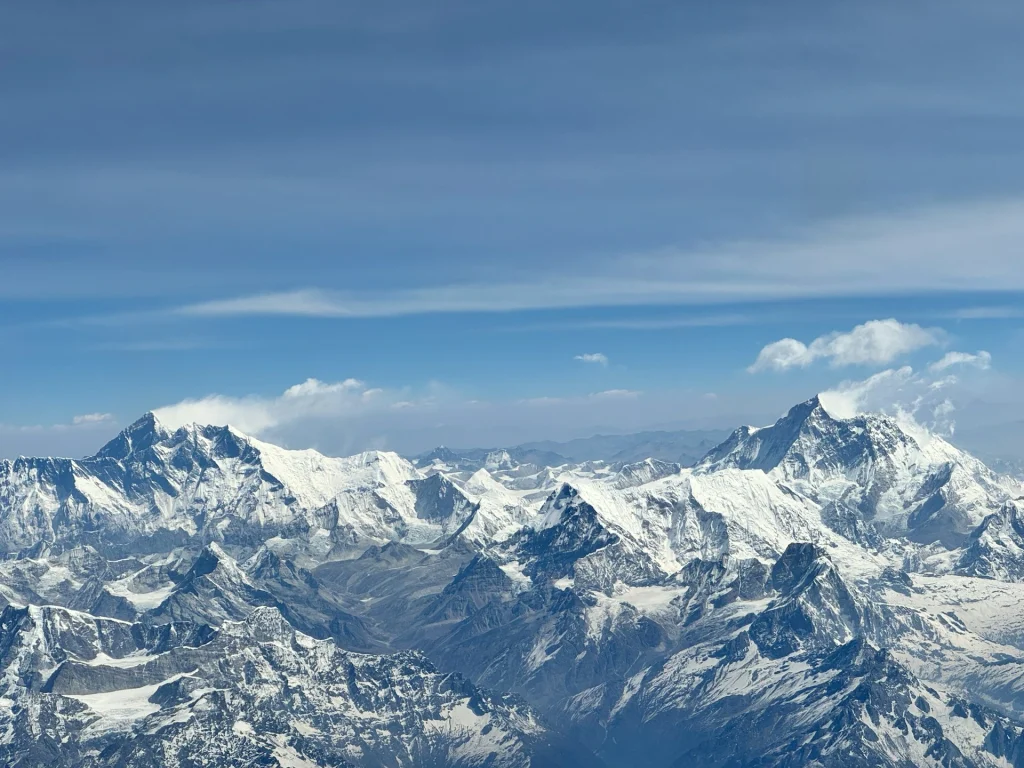
This is our Everest Above the Clouds journey, and it is the version of Everest we recommend for ten days. A private helicopter takes you from Kathmandu to Lukla, which avoids the drive to Manthali for the scheduled flights and the long wait there on mornings when the weather shuts the airstrip at Lukla. Then you walk the lower Khumbu for four days, up to Namche at 3,500m and Tengboche at 3,867m, sleeping in the best lodges each night as far as Deboche.
On day seven a helicopter lifts off near Deboche and flies over Base Camp, where landings are not permitted, then sets down at Kala Patthar, 5,545m, when the weather allows. The walking comes first for a reason. The UIAA’s medical commission lists a fast ascent as a risk factor for altitude illness, and by day seven you have already slept at Namche and Deboche, so your body has had several nights to adjust before the helicopter carries you higher than you have walked. Day eight is slow, and it doubles as the weather margin. On day nine a Sherpa who has stood on the summit of Everest joins you for the evening.
| Days | Where | What happens | Nights |
|---|---|---|---|
| 1 | Kathmandu | Arrival | The Dwarika’s, Kathmandu |
| 2 | Kathmandu | The sacred sites of the Valley | The Dwarika’s, Kathmandu |
| 3 | Phakding | A private helicopter to Lukla, then a short walk | Premium mountain lodge |
| 4 to 5 | Namche Bazaar | Up to Namche, then the Sherpa villages above it | Premium mountain lodge |
| 6 | Deboche | Tengboche Monastery, then down to Deboche | Premium mountain lodge |
| 7 | Kathmandu | Over Base Camp by helicopter, landing at Kala Patthar if the weather allows | The Dwarika’s, Kathmandu |
| 8 | Kathmandu | A slow day in the Valley, and the margin | The Dwarika’s, Kathmandu |
| 9 | Kathmandu | An evening with an Everest summiter | The Dwarika’s, Kathmandu |
| 10 | Kathmandu | Departure |
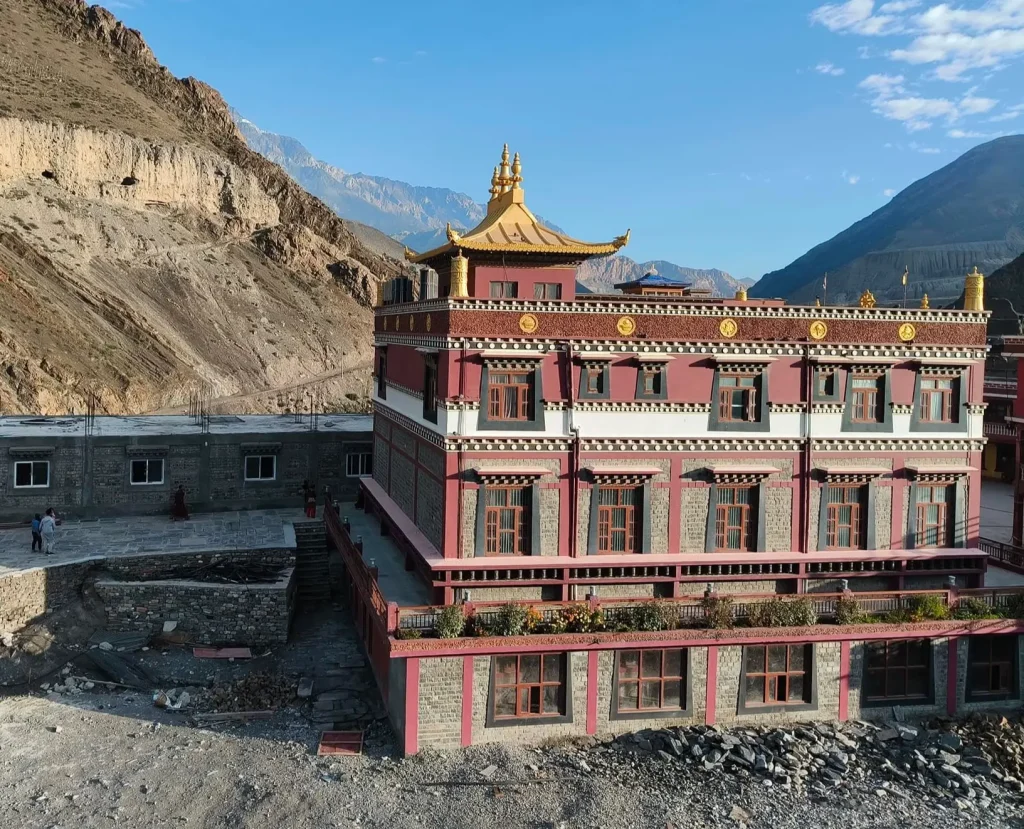
Mustang sits behind the Himalaya in its rain shadow, a high desert of eroded cliffs and walled villages along the Kali Gandaki. It gets less than 300mm of rain a year, so it is one of the few parts of Nepal that works in the monsoon, as our guide to Jomsom explains, and this is the route for summer, when cloud hides most of the mountains from the south of the range. The river runs highest then, so conditions in the valley are checked before every departure. You fly to Jomsom early, before the wind rises in the gorge, and stay at Shinta Mani Mustang for five nights, which means you unpack once and spend the days going out to the villages instead of moving between them.
All the days run south of the restricted line, so no special permit is needed. Marpha is the apple capital of Nepal. Kagbeni is the gateway north, home to Kag Chode Monastery. Muktinath, at just under 3,800m, is sacred to Hindus and Buddhists alike. Day eight has nothing planned, so it can be a ride, a walk with a guide, a session of yoga, or simply the lodge and the view.
| Days | Where | What happens | Nights |
|---|---|---|---|
| 1 to 2 | Kathmandu | Arrival, then the Valley before the Himalaya | Heritage hotel, Kathmandu |
| 3 | Pokhara | A short flight west | Luxury property, Pokhara |
| 4 | Jomsom | The early flight north, and an afternoon at the lodge | Shinta Mani Mustang |
| 5 | Marpha | The apple capital, and its stone streets | Shinta Mani Mustang |
| 6 | Kagbeni | The gateway north, and Kag Chode Monastery | Shinta Mani Mustang |
| 7 | Muktinath | Jharkot and Jhong on the way up to the temple | Shinta Mani Mustang |
| 8 | Mustang | Nothing planned | Shinta Mani Mustang |
| 9 | Kathmandu | Fly out by way of Pokhara | Luxury hotel, Kathmandu |
| 10 | Kathmandu | Departure |
This is The Kingdom of Mustang as we offer it. With four more days, Lo Manthang in Upper Mustang comes within reach, and our 14 day itinerary lays that route out.
This route suits guests who have seen mountains before, or who want the trip to slow them down. Chitwan, Nepal’s first national park and a UNESCO World Heritage site since 1984, gets three nights, which is enough to choose your conditions rather than stake everything on a single drive. The 2026 census counted 145 tigers in the park. Rhinos are close to reliable and tigers are never promised, as our Nepal safari guide explains. At the elephant camp the herd is kept free of chains and nobody rides them, so you walk beside them while they browse and watch them bathe, which makes a far better morning than sitting on one ever did.
Then you fly back to Kathmandu and drive east to the ridge at Dhulikhel for three nights of rest, where the days are built around the body after the early starts of the jungle. Yoga comes first, while the morning air is still cold, and Ayurveda follows a consultation. On the last full day you can walk to Namo Buddha, about three hours through terraced hills, where a stupa marks the story of a prince who gave his own body to a starving tigress.
| Days | Where | What happens | Nights |
|---|---|---|---|
| 1 to 2 | Kathmandu | Arrival, then the Valley | Heritage hotel, Kathmandu |
| 3 to 5 | Chitwan | A short flight to Bharatpur. Three days in the park, and the elephant camp | Jungle lodge, Chitwan |
| 6 to 8 | Dhulikhel | Back to Kathmandu, then east to the ridge. Yoga, Ayurveda, and the walk to Namo Buddha | Wellness retreat, Dhulikhel |
| 9 | Kathmandu | Bhaktapur on the way back. The spare day | Heritage hotel, Kathmandu |
| 10 | Kathmandu | Departure |
The jungle days come from The Wild Himalaya and the ridge from Himalayan Renewal.
If you are unsure, start from what you most want to bring home. The table puts it plainly.
| If what you want most is | The route | Walking | High point |
|---|---|---|---|
| The mountains close up, with no altitude to manage | The Annapurna foothills | A few hours a day on stone paths | About 2,000m |
| Everest itself | Everest from the air | Four days, moderate | 3,867m on foot |
| A landscape unlike the rest of Nepal | The kingdom of Mustang | Short walks from the lodge | Just under 3,800m |
| Wildlife, and a slower pace | Wildlife, then rest | Gentle | About 1,550m |
Yes, in two ways. The simpler is the mountain flight from Kathmandu, which the Nepal Tourism Board describes as an hour-long flight, usually in the morning, past several peaks above 8,000m, Everest among them. It fits into a Kathmandu morning on any of the four routes, and because it lands back where it took off, the rest of the plan does not have to change around it.
The fuller way is route two, which walks you into the Khumbu and then flies you higher. What ten days cannot do is walk you to Base Camp. The Tourism Board’s own estimate for that is about two weeks on foot, as our guide to the luxury Everest Base Camp trek sets out.
The Department of Hydrology and Meteorology gives the monsoon normal dates of 13 June to 2 October, and the two months after it are the clearest of the year, as our guide to the best time to trek in Nepal explains. The table shows how that plays out for each route.
| Route | Best | Also good | We would avoid |
|---|---|---|---|
| The Annapurna foothills | October and November | December to April | June to September, the wettest months |
| Everest from the air | October and November | December to May | June to September, the wettest months |
| The kingdom of Mustang | June to October | March to May, and November | December to February, when flights pause |
| Wildlife, then rest | October to March | April | June to September, the wettest months |
Two things can move these lines. In some springs, smoke and haze hide the Annapurna range from Pokhara and Ghandruk. In December and January, fog can close lowland airports in the morning, so a winter safari keeps time in hand.
Two more days change what is possible. With twelve, Chitwan can join the Valley and Pokhara, as it does on our Wild Himalaya journey. With fourteen, you can walk to Annapurna Base Camp, pair Everest with the jungle, reach Lo Manthang in Upper Mustang, or keep the foothills and add both Chitwan and Dhulikhel. Our 14 day itinerary lays out each of those, day by day.
In our experience, a short trip goes wrong in the transfers more often than in the places. So we plan the moves first, deciding which mornings fly and where the spare day sits, and only then fill in the days between.
For example, on our Mustang journey the flight to Jomsom leaves early, because the wind comes up the Kali Gandaki later in the day, and day eight is left unplanned so that it can absorb a held flight. On our Everest journey, a helicopter from Kathmandu replaces the drive to Manthali and the wait for seats there.
We also keep the Valley in every route, however short. Two days among its temples and workshops is where the rest of Nepal begins to make sense, and the monasteries of the high valleys read differently once you have seen where so much of the country’s faith and craft took shape.
Each route here is one of our private journeys, or is drawn from them, and each can be reshaped around your dates. Every journey is private, for up to five guests, with a private vehicle and driver throughout, a host from our office, a spare day near the end and a briefing on arrival about what to do in an emergency. For the groundwork, such as visas and the order of the regions, see our tour plan for Nepal, and for what comfort means on the trail, our guide to luxury trekking in Nepal. When you know your dates, tell us what you most want from the ten days, and we will draft the route with you.
Yes, for the Kathmandu Valley and one region beyond it, with a spare day for the weather. Ten days suits the Annapurna foothills, Everest by helicopter, Lower Mustang, or Chitwan followed by rest at Dhulikhel. It is too short for Everest Base Camp on foot, which takes about two weeks.
For a first visit, three nights in the Kathmandu Valley, a 25-minute flight to Pokhara, two nights in the Gurung village of Ghandruk facing Annapurna South and Machhapuchhre, and a spare day back in Kathmandu. It never climbs much above 2,000m, so altitude never sets the pace.
Yes. A ten-day route can fly to Lukla by private helicopter, walk to Tengboche at 3,867m, then fly over Everest Base Camp and land at Kala Patthar when the weather allows. For less effort, the hour-long mountain flight from Kathmandu passes Everest and several other peaks above 8,000m.
Not on foot. The Nepal Tourism Board puts the walk at about two weeks, because the body needs time to adjust to the altitude. In ten days you can walk the lower Khumbu and see Base Camp from a helicopter, although landing at Base Camp itself is not permitted.
Yes, Lower Mustang: Jomsom, Marpha, Kagbeni and Muktinath, none of which needs a restricted area permit. Lo Manthang, in Upper Mustang, needs a restricted area permit that an agency must file, and about four more days.
Only by giving up the walking. Each move between regions uses most of a day, so the Valley, Chitwan and Pokhara together leave little time in any of them. We would pair Chitwan with rest at Dhulikhel, and keep the foothills for a longer trip.
October and November, after the monsoon has withdrawn and the mountains are clearest. March and April come next. From June to September, choose Mustang: it lies in the rain shadow and gets less than 300mm of rain a year, against 3,345mm in Pokhara.
Send us your questions about routes, costs or the best time to go — our travel experts in Nepal reply within 24 hours.

A tour plan for Nepal works best built around three or four places, not eight. The country is small on a map and slow on the ground, so the itineraries…
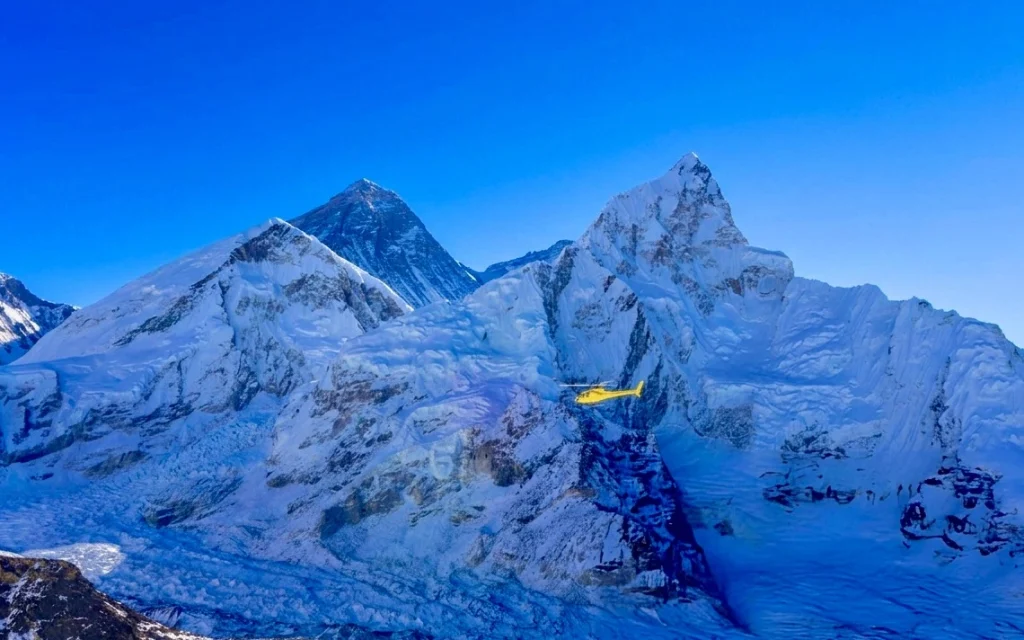
An Everest Base Camp helicopter tour flies up the Khumbu, passes over Base Camp and, when the weather allows, lands at Kala Patthar. Landing at Base Camp itself is not…